
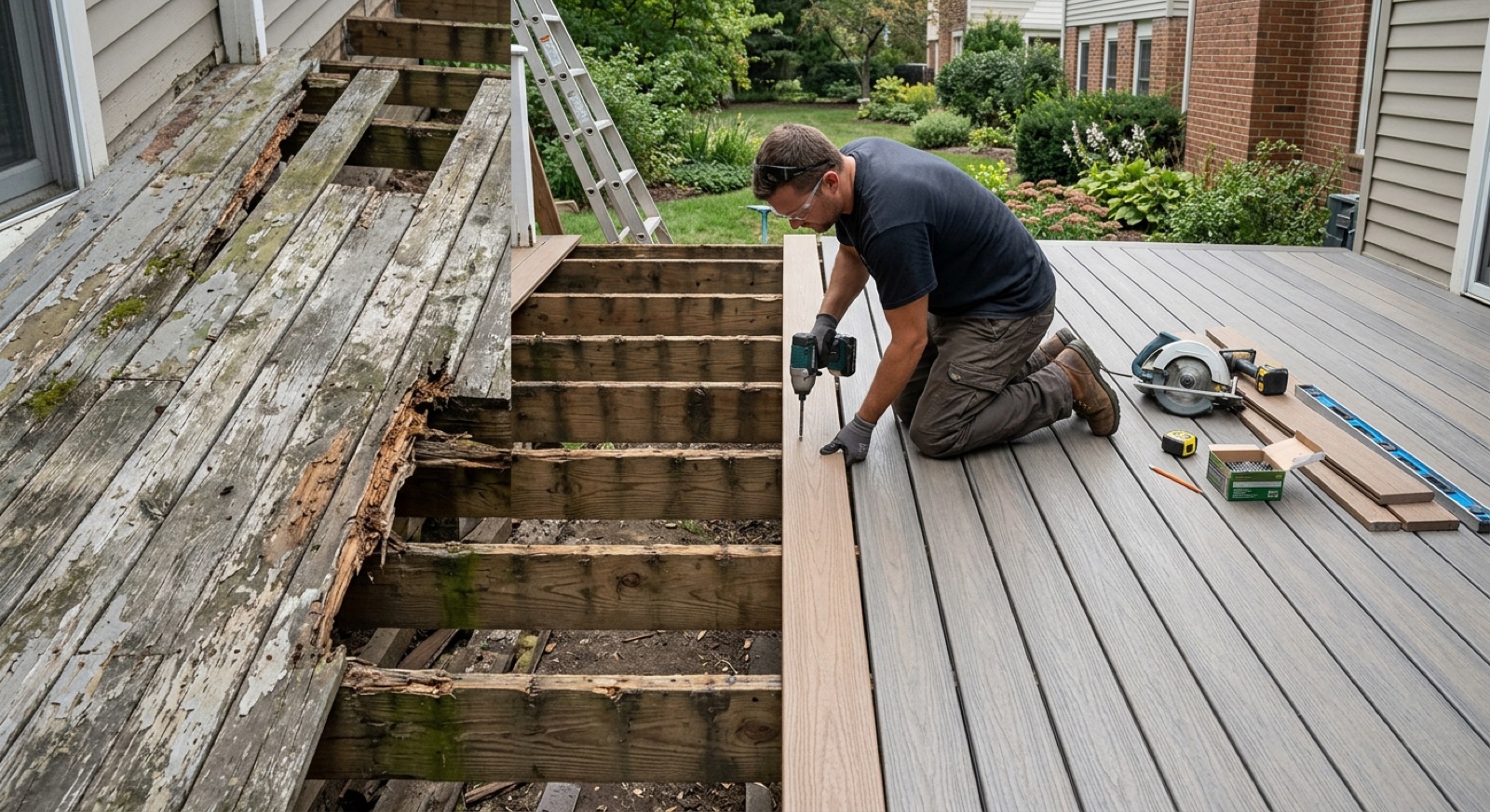
Protect Your Investment with Professional Deck Care
Your deck is one of the most used and most exposed structures on your property. Every day it faces direct sunlight, rain, foot traffic, furniture weight, and the constant humidity that defines life in Rock Hill and York County. Without regular maintenance and timely repairs, even the best-built deck will deteriorate faster than it should. At Rock Hill Decks, we offer comprehensive repair and maintenance services that extend the life of your deck by years and keep it looking its best every season.
Whether you have a small section of soft boards that need replacing or a deck that hasn't been touched in five years and needs a complete restoration, our team has the experience and tools to bring it back to life. We service all deck types including pressure-treated lumber, cedar, composite, and exotic hardwood across Rock Hill, Fort Mill, Tega Cay, York, Indian Land, Lake Wylie, and Clover.
Common Deck Repairs We Handle
Years of building and repairing decks in the Rock Hill area have shown us the most common problems homeowners face. Catching these issues early saves thousands in more extensive repairs down the line.
- Rotted or Soft Boards: Wood rot is the number one deck killer in our humid climate. We remove damaged boards and replace them with matching material, checking the joists underneath for hidden damage.
- Loose or Wobbly Railings: Railing connections weaken over time from seasonal expansion and contraction. Loose railings are a serious safety hazard, especially for families with children. We re-secure or replace railing posts, balusters, and top rails.
- Popped or Corroded Fasteners: Deck screws and nails back out over time. Corroded fasteners lose holding power and create rust stains. We replace failed fasteners with appropriate corrosion-resistant hardware.
- Structural Issues: Sagging decks, bouncy spots, and cracked beams indicate structural problems in the joists, ledger board, or support posts. These require immediate attention and are the most important repairs we perform.
- Stair Damage: Deck stairs take more abuse than any other component due to concentrated foot traffic. We rebuild treads, stringers, and handrails to restore safe access.
Annual Maintenance Plans
The most cost-effective way to care for your deck is with a consistent annual maintenance plan. Our maintenance service includes a complete structural inspection, power washing with deck-safe detergent, minor repairs like tightening fasteners and replacing individual boards, and a fresh coat of stain or sealer if your deck is due.
We schedule maintenance visits in the spring, after winter weather has passed but before the heat of summer accelerates UV damage. This timing gives your deck maximum protection during the months it gets the heaviest use. Our maintenance clients see their decks last 30 to 50 percent longer than decks that receive only reactive repairs.
For composite decks, annual maintenance is simpler but still important. We inspect all fastener points, clean mold and mildew from the surface (yes, composite can still grow surface mold), check railing connections, and examine the substructure for any signs of moisture damage at connection points.
When to Repair vs. When to Replace
This is the most common question we get, and the answer depends on the extent and location of the damage. As a general rule, if the substructure (joists, beams, posts, and ledger board) is still solid and the damage is limited to surface components, repair is almost always the better value. Replacing a few boards, rebuilding a section of railing, or re-staining the entire surface costs a fraction of a new build.
Replacement becomes the smarter choice when the substructure itself has widespread rot or insect damage, when the deck was built with undersized lumber that doesn't meet current codes, or when more than half the decking boards need replacement. In these cases, the cost of piece-by-piece repair approaches or exceeds the cost of starting fresh with new materials and a modern design.
We never push replacement when repair will do the job. Our free inspection gives you an honest assessment with photos of any damage we find, so you can make an informed decision. If replacement is warranted, we'll credit the inspection toward your new build.
Frequently Asked Questions
If the damage is limited to surface boards, railings, or isolated areas, repair is usually the best option. Full replacement is recommended when the substructure (joists, beams, posts) shows widespread rot, when more than 50% of the deck boards are damaged, or when the deck no longer meets current building codes. We offer free inspections to help you decide.
Deck repair costs in Rock Hill vary widely depending on the scope of work. Minor repairs like replacing a few boards or tightening railings typically cost $200 to $800. Structural repairs involving joists or posts range from $1,000 to $5,000. A full re-staining job for a 300 sq ft deck runs $800 to $1,500. We provide detailed estimates before starting any work.
We recommend annual professional maintenance for wood decks in the Rock Hill area. This includes a thorough inspection, cleaning, and re-staining if needed. Composite decks need less frequent attention but should still be inspected annually for fastener issues and cleaned at least once per year.
Warping and splitting are caused by moisture cycling -- the repeated absorption and release of water in wood fibers. In Rock Hill's humid climate, this is accelerated by intense summer heat followed by afternoon thunderstorms. Proper staining and sealing creates a moisture barrier that dramatically slows this process.
We can get very close to matching existing boards through careful stain selection and application techniques. For the best results, we often recommend re-staining the entire deck surface after repairs, which ensures a uniform appearance and refreshes the protective coating on older boards at the same time.